
BlogConsultancy

Climate Risk and Vulnerability Assessment: What Government Agencies and International Organizations Must Know Before Investing in MENA

For decision-makers in government ministries, development finance institutions, and intergovernmental bodies, climate risk is no longer a background consideration — it is a front-line investment variable. Across the Middle East and North Africa, the physical consequences of climate change are accelerating, while the policy landscape is shifting fast enough to create new categories of financial exposure almost overnight. Before committing capital or signing off on a large-scale project in this region, organizations need a structured, evidence-based understanding of what they are walking into. That understanding begins with a rigorous climate risk and vulnerability assessment.

Why Climate Risk Assessment Has Become Non-Negotiable for Public Sector Decision-Making

Ten years ago, climate risk was largely the domain of environmental impact reports — a compliance box to be ticked before a project moved forward. Today, it sits at the center of institutional governance, investment due diligence, and sovereign planning cycles. The shift has been driven by a combination of regulatory pressure, investor expectation, and the increasingly visible cost of getting it wrong.

The TCFD Framework — Why It Is Now the Baseline Standard for Institutional Climate Disclosure

The Task Force on Climate-related Financial Disclosures, better known as TCFD, has become the de facto international framework for understanding and communicating climate-related risk. Originally developed for private sector financial institutions, its logic — assess exposure across physical and transition risk, stress-test strategy against climate scenarios, disclose findings in governance and financial reports — has been adopted widely by sovereign entities, multilateral lenders, and public agencies. For any government body or international organization seeking to access development finance, align with global sustainability standards, or demonstrate credible climate governance, fluency in the TCFD framework is no longer optional. It is the language in which climate accountability is now written.

How Development Finance Institutions Use CVAs in Project Approval

Development finance institutions including the World Bank Group, the European Bank for Reconstruction and Development, and the Agence Française de Développement have embedded climate risk and vulnerability assessment into their project appraisal processes. A proposal for infrastructure investment, urban development, or agricultural modernization in a climate-exposed region will not clear internal review without a credible CVA component. These institutions use assessment findings to determine whether a project is structurally resilient enough to deliver expected returns over its operational lifetime, and to identify what adaptation measures need to be built into the design from the outset. For MENA governments and institutions seeking grant funding or concessional lending, this means that commissioning a thorough climate risk assessment is not a preparatory step — it is a prerequisite.

The Regulatory and Reputational Cost of Ignoring Climate Risk in Public Sector Planning

The consequences of skipping robust climate risk analysis are no longer theoretical. Infrastructure built without accounting for shifting precipitation patterns has failed ahead of schedule. Coastal developments have been stranded by accelerating erosion. Urban systems designed without heat resilience have faced productivity crises during extreme weather events. Beyond direct financial loss, the reputational cost to public agencies that have approved projects later shown to have ignored available climate intelligence is significant and growing. In an era of heightened scrutiny over public investment, climate strategy consulting that identifies and mitigates risk before commitment is a governance responsibility, not a discretionary service.

Physical vs. Transition Risk — The Two Dimensions Every Assessment Must Address

A rigorous climate change risk assessment framework does not treat climate as a single undifferentiated threat. It distinguishes between two fundamentally different — though interacting — categories of risk: physical risk, which arises from the changing climate itself, and transition risk, which arises from the economic and policy response to that change. Both must be assessed; organizations that focus only on one routinely underestimate their total exposure.

Physical Risk Explained — Acute Events and Chronic Shifts

Physical risk comes in two forms. Acute physical risks are the event-driven shocks — floods triggered by intense rainfall, heatwaves that exceed safe operational thresholds, cyclones, or wildfires. These are the hazards that make headlines, damage assets, disrupt supply chains, and force emergency response. Chronic physical risks are slower-moving but in many ways more consequential for long-term investment: the gradual rise of sea levels, the sustained intensification of water stress across arid and semi-arid regions, the creeping desertification of agricultural land, and the long-term shift in temperature baselines that affects everything from energy demand patterns to crop viability. Both dimensions require separate analytical treatment within any credible climate risk assessment.

Transition Risk Explained — Policy Changes, Technology Disruption, and Stranded Assets

Transition risk emerges not from the climate itself, but from the world’s response to it. Policy changes — carbon pricing, emissions mandates, fossil fuel subsidy reform — can alter the economic logic of existing assets almost overnight. Technological shifts, such as the accelerating cost reduction of renewable energy, can strand conventional infrastructure investments that were financially sound just a decade ago. For government agencies managing public infrastructure portfolios, and for international organizations financing development projects, understanding transition risk means asking a simple but uncomfortable question: will this investment still make economic sense in a world aligned with net-zero commitments? If the answer is uncertain, that uncertainty must be quantified and addressed.

How Physical and Transition Risks Interact in the MENA Context

In MENA, these two risk categories do not operate in isolation — they interact in ways that amplify total exposure. Consider a country heavily dependent on hydrocarbon revenues. Physical climate change threatens the operational viability of extraction infrastructure through extreme heat and water scarcity, while transition risk threatens the long-term market for the product itself. Or consider a coastal city in Egypt where public infrastructure faces growing flood exposure from sea-level rise at the same time that national climate commitments are driving large-scale shifts in how energy and water systems are planned and financed. A credible climate risk assessment for any MENA investment must model both dimensions simultaneously, and account for how they interact under different climate scenarios.

Egypt-Specific Climate Hazards Every Assessment Must Address

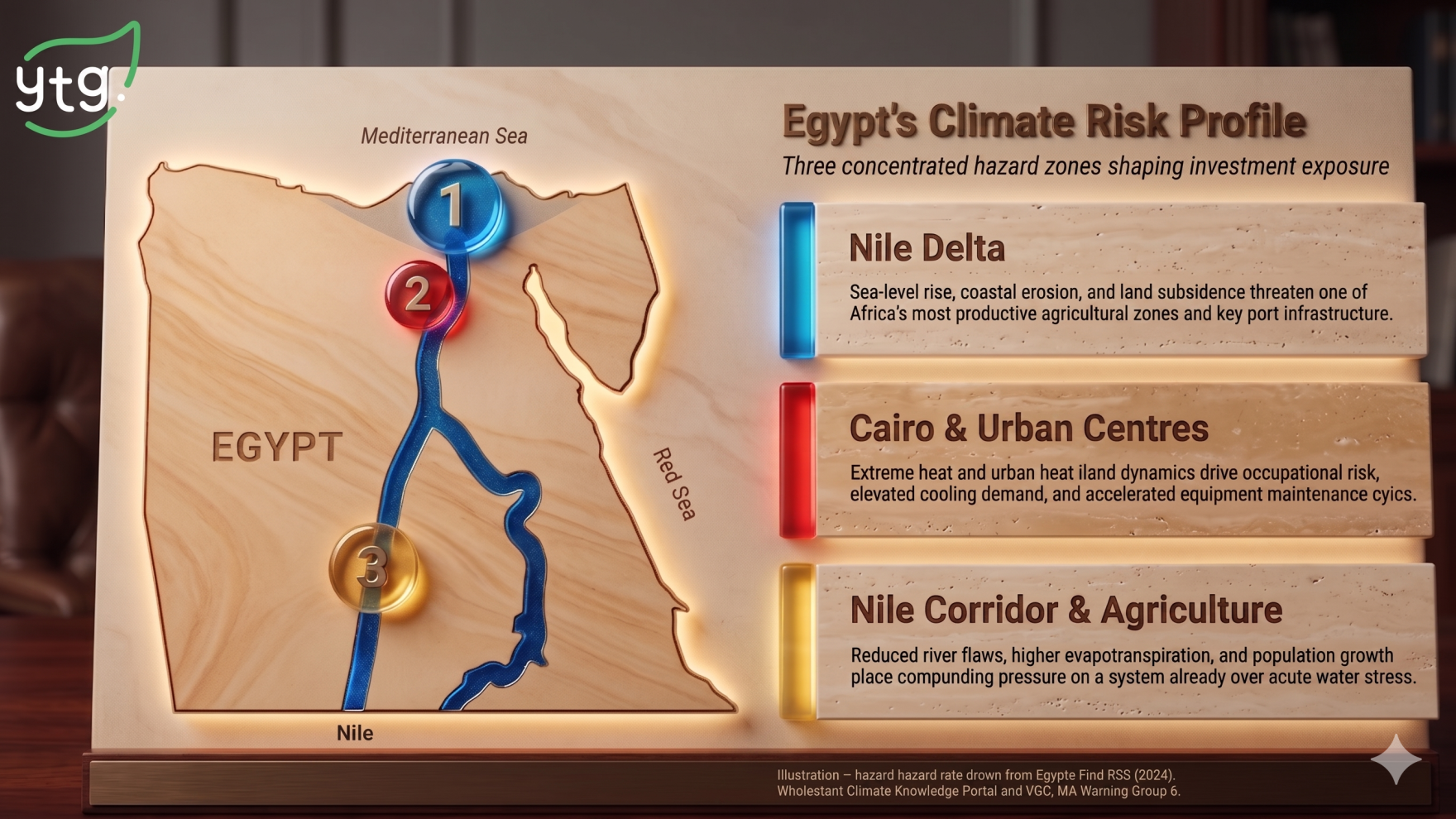
Egypt presents a risk profile that is at once highly specific and instructive for the broader MENA region. Its geography — a narrow inhabited corridor flanked by desert, bisected by the Nile, and open to a changing Mediterranean — concentrates climate exposure in ways that have direct implications for infrastructure, investment, and human systems.

Nile Delta Flooding and Coastal Erosion — Exposure and Asset Vulnerability

The Nile Delta is one of the most densely populated and economically productive agricultural zones in Africa, and also one of the most climate-exposed. It sits at or near sea level across large portions of its extent, making it acutely vulnerable to the combination of Mediterranean sea-level rise and land subsidence — the latter exacerbated by the reduction in sediment flow following the construction of the Aswan High Dam. Coastal erosion is already a measurable and documented trend along significant stretches of the Delta coastline. For organizations investing in port infrastructure, agricultural supply chains, coastal industrial zones, or urban development in this area, exposure mapping is not an abstract modelling exercise. It is an immediate material concern that must be central to any climate risk assessment for business or public investment in the region.

Extreme Heat and Urban Heat Islands — Operational and Workforce Risk

Egypt’s urban centers — and Cairo in particular — are experiencing the compounding effects of rising ambient temperatures and urban heat island dynamics, where dense built environments absorb and retain heat at rates that consistently exceed surrounding rural areas. Average summer temperatures in Cairo are now regularly reaching levels that carry genuine occupational health risk for outdoor workers and impose significant costs on energy systems through elevated cooling demand. For government agencies and infrastructure investors, this means that operational risk assessments must account for heat-related productivity losses, increased maintenance cycles for equipment operating in high-temperature environments, and the rising energy costs associated with cooling. Workforce resilience and the operational continuity of public services under extreme heat conditions are not soft concerns — they are hard financial variables.

Water Scarcity and Agricultural Stress — Supply Chain and Food Security Exposure

Egypt is classified as one of the most water-scarce countries in the world, with per-capita freshwater availability well below international thresholds. Reduced Nile flows, increased evapotranspiration driven by higher temperatures, and growing demand from an expanding population are all placing compounding pressure on a water system that is already stretched close to its limits. For international organizations working on food security, rural development, or agricultural investment, this creates layered supply chain exposure that extends far beyond Egypt’s borders — disruptions to Egyptian agricultural output affect regional food systems across MENA and parts of Sub-Saharan Africa. Any comprehensive climate risk assessment for business or development investment in this sector must treat water scarcity not as a single risk variable, but as a systemic driver of interconnected exposures.

The Climate Risk and Vulnerability Assessment Process

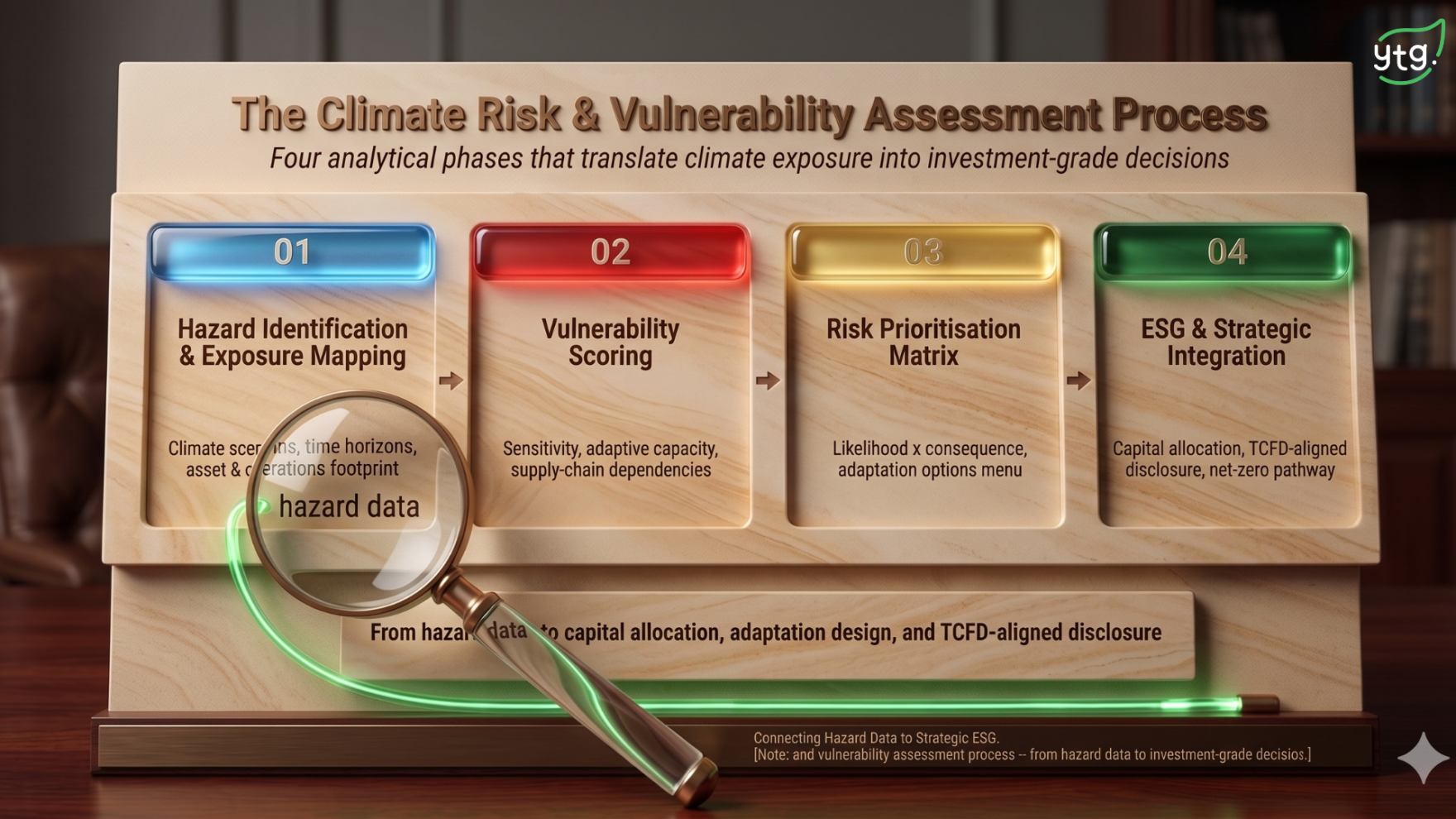
Understanding climate risk conceptually is one thing. Translating that understanding into decision-grade analysis that can support investment planning, adaptation design, and strategic disclosure is another. A structured, four-phase CVA process provides the methodological backbone for doing that work rigorously.

Phase 1 — Hazard Identification and Exposure Mapping

The assessment begins by identifying the full set of climate hazards relevant to the geography and sector in question, drawing on global climate models, regional downscaling data, and historical hazard records. This is not a checklist exercise. It requires selecting appropriate climate scenarios — typically aligned with the IPCC’s Representative Concentration Pathways — and projecting hazard profiles across short, medium, and long time horizons. Exposure mapping then determines which assets, operations, and communities fall within the footprint of each identified hazard, establishing the raw material for vulnerability analysis.

Phase 2 — Vulnerability Scoring Across Assets, Operations, and Supply Chains

Exposure is not the same as vulnerability. A coastal asset may be exposed to storm surge risk but highly resilient by virtue of its design specifications, elevation, or engineering standards. Vulnerability scoring moves beyond proximity to assess the sensitivity of each exposed element — its structural characteristics, operational dependencies, adaptive capacity, and the consequences of failure. This phase is where sector-specific technical expertise becomes critical. Scoring vulnerability across infrastructure assets, operational systems, and supply chain nodes requires a command of both climate science and the engineering and operational realities of the systems being assessed.

Phase 3 — Risk Prioritization Matrix and Adaptation Options

With hazard exposure and vulnerability scores established, the third phase builds a risk prioritization matrix that ranks identified risks by likelihood and consequence across the defined time horizons. This is the analytical product that most directly informs investment decision-making: it tells decision-makers which risks demand immediate attention, which can be managed through monitoring, and which can be addressed through longer-term adaptation investment. Alongside the matrix, this phase generates a structured menu of adaptation options — engineered interventions, operational modifications, policy measures, or financial risk transfer mechanisms — assessed for cost-effectiveness, feasibility, and alignment with national and sectoral climate strategies.

Phase 4 — Integration into ESG Implementation and Strategic Planning

A CVA that ends with a risk matrix has not finished its job. The final phase is integration: feeding the assessment findings into the organization’s broader ESG implementation framework, its strategic planning cycles, its disclosure obligations, and its investment pipeline. This is where the assessment translates from analysis into action — informing capital allocation decisions, shaping adaptation project design, supporting TCFD-aligned disclosure reporting, and feeding directly into the organization’s net zero trajectory. For organizations already engaged in ESG implementation work, a well-executed CVA is not a standalone deliverable. It is a foundational input that gives the entire sustainability programme its empirical grounding.

From Assessment to Action — Building Climate Resilience into Your Organization

Completing a climate risk and vulnerability assessment is a significant analytical achievement. But the return on that investment is only realized if the findings are systematically embedded into the decisions that follow. This is the difference between an organization that understands its climate exposure and one that is genuinely building resilience.

How CVA Results Feed into Net Zero Strategy and Investment Planning

The outputs of a CVA have direct and practical implications for net zero strategy. Physical risk findings identify which assets or operations may need to be retired, retrofitted, or relocated — changing the composition and timeline of any net zero investment plan. Transition risk analysis informs which technology investments are defensible over the long term and which carry stranded-asset exposure that needs to be priced into financial modelling. For organizations developing or refining a net zero strategy, CVA results are not supplementary inputs — they are the reality check that ensures the strategy is grounded in the actual risk landscape rather than constructed in isolation from it. As covered in our article on carbon footprint assessment, knowing your emissions baseline is essential; knowing how your physical and transition risk profile interacts with your decarbonisation pathway is what makes that baseline actionable.

Aligning Climate Adaptation with Egypt’s National Climate Resilience Frameworks

Egypt has made significant commitments under its National Determined Contribution, its National Adaptation Plan, and the broader Egypt Vision 2030 framework — all of which contain explicit climate resilience objectives for infrastructure, water, agriculture, and coastal management. For government agencies, development partners, and investors operating in Egypt, aligning adaptation investment with these national frameworks is both a governance requirement and a practical advantage: projects designed in alignment with national climate priorities are better positioned to access public co-financing, secure regulatory approval, and sustain political support over multi-year implementation cycles. Effective climate risk assessment consulting in this context means not only identifying what needs to be done to manage risk, but positioning that action within the national planning architecture that will determine whether it gets done at all.

The organizations that will be best positioned across the MENA region over the next decade — whether they are government ministries managing public infrastructure, development banks deploying concessional finance, or international bodies executing multi-country programmes — are those that have moved beyond treating climate risk as an external variable and have begun building it into the core logic of how they plan, invest, and report. A rigorous climate risk and vulnerability assessment is not the end of that process. It is where it starts.

How to Reduce Energy Costs in Egyptian Factories: 8 Proven Strategies for Industrial Operators
How to Conduct an ESG Gap Analysis: A Step-by-Step Framework for Public Sector and Government Organizations

Get in touch with our team

For further inquiries, talk with one of our experts.