

For ministries, development finance institutions, and infrastructure investors operating in Egypt, climate risk has shifted from a compliance footnote to a core variable in capital allocation. Sea-level rise on the Mediterranean coast, intensifying heat in urban centres, and tightening water availability are now reshaping the economics of long-lived assets across the country.
Against this backdrop, a structured climate risk assessment in Egypt is no longer a discretionary exercise — it is the analytical foundation on which credible investment, planning, and disclosure decisions now rest.
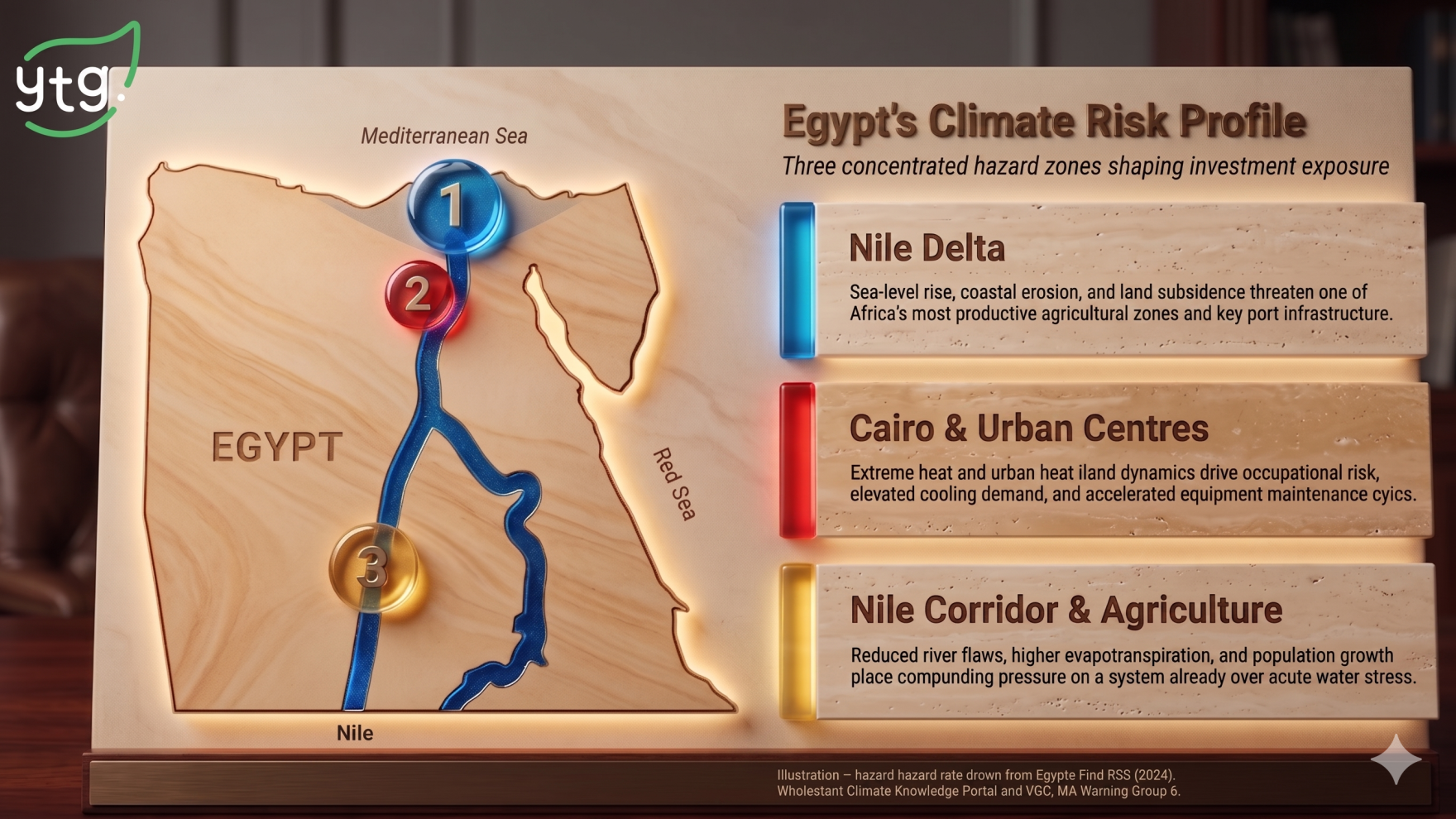
Figure 1. Egypt’s three concentrated climate hazard zones — Nile Delta, urban centres, and the Nile corridor — each carrying distinct investment implications.
Why Climate Risk Assessment in Egypt Has Become a Boardroom Priority
A decade ago, climate risk in Egypt was largely confined to environmental impact reports prepared at the end of a project cycle. Today, it sits at the centre of governance, investor due diligence, and sovereign planning. The shift has been driven by three forces: the rise of the Task Force on Climate-related Financial Disclosures (TCFD) as the de facto international standard for climate disclosure; the embedding of climate vulnerability assessment requirements into the appraisal processes of the World Bank, the European Bank for Reconstruction and Development, and the Agence Française de Développement; and the visible cost of getting it wrong on infrastructure designed without climate intelligence.
For Egyptian public agencies and international organisations seeking concessional finance, a credible climate risk assessment in Egypt is now a prerequisite, not a preparatory step. It is also the language in which climate accountability is increasingly written – fluency in TCFD-aligned disclosure has become indistinguishable from credible climate governance.
The Climate Hazards Shaping Egypt’s Risk Profile
Egypt’s geography concentrates climate exposure in ways that demand sector-specific analysis. A meaningful climate risk assessment in Egypt must move beyond generic hazard mapping and engage with the country’s specific physical realities, drawing on national datasets and global tools such as the World Bank Climate Knowledge Portal.
Nile Delta Exposure and Coastal Erosion
The Nile Delta is one of the most densely populated and economically productive agricultural zones in Africa, and one of the most climate-exposed. Large parts of the Delta sit at or near sea level, making it vulnerable to the combined effects of Mediterranean sea-level rise and land subsidence — the latter exacerbated by reduced sediment flow downstream of the Aswan High Dam. Coastal erosion is already a measurable trend along significant stretches of the Delta coastline. For port operators, agricultural supply chains, coastal industrial zones, and urban developers, exposure mapping is not an abstract modelling exercise. It is an immediate material concern.
Extreme Heat in Cairo and Urban Centres
Cairo and Egypt’s other major urban centres are experiencing the compounding effects of rising ambient temperatures and urban heat island dynamics. Summer temperatures now regularly reach levels that carry occupational health risks for outdoor workers and impose significant costs through elevated cooling demand. A climate vulnerability assessment for any urban infrastructure investment must therefore account for heat-related productivity losses, accelerated equipment maintenance cycles, and the rising operating costs of cooling — all hard financial variables, not soft concerns.
Water Scarcity and Agricultural Stress
Egypt is classified among the most water-scarce countries in the world, with per-capita freshwater availability well below international thresholds. Reduced Nile flows, higher evapotranspiration, and growing demand from a rising population are placing compounding pressure on a system already stretched close to its limits. For investors in agriculture, food security, or rural development, this creates layered supply chain exposure that extends well beyond Egypt’s borders.
Physical and Transition Risk in the Egyptian Context
A rigorous climate risk assessment in Egypt distinguishes between physical risk — the consequences of the changing climate itself — and transition risk, which arises from policy, technology, and market responses to that change. Both categories must be analysed; organisations that focus only on one routinely underestimate their total exposure.
In Egypt the two dimensions interact directly. Hydrocarbon-linked assets face physical risk from extreme heat and water scarcity at the same time that global decarbonisation tightens the long-term market for the product itself. Coastal infrastructure faces sea-level rise while national climate commitments — embedded in Egypt’s First Biennial Transparency Report and updated NDC — drive structural shifts in how energy and water systems are financed. A serious climate risk assessment in Egypt must therefore model both dimensions under multiple scenarios, including those aligned with the IPCC’s Working Group II findings on regional impacts and adaptation.
How a Climate Risk Assessment in Egypt Translates into Action
A credible assessment moves through four analytical phases: hazard identification and exposure mapping; vulnerability scoring across assets, operations, and supply chains; risk prioritisation across short, medium, and long horizons; and integration into ESG, capital allocation, and disclosure cycles.
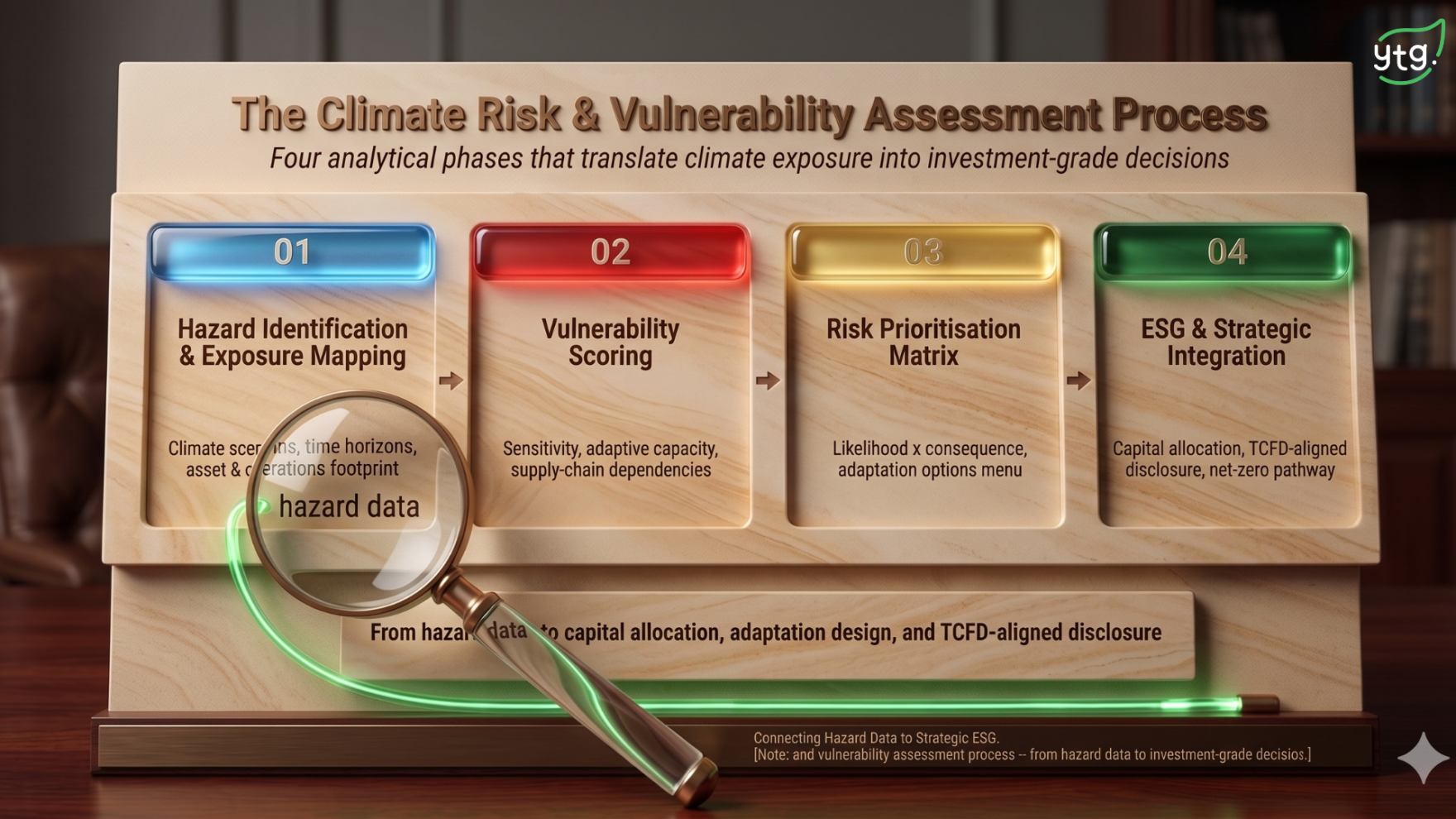
Figure 2. The four-phase climate risk and vulnerability assessment process — from hazard data to investment-grade decisions.
The final phase is where most assessments fail. A climate risk assessment in Egypt that ends at a risk matrix has not finished its job. Findings must feed into investment pipelines, adaptation design, and TCFD-aligned reporting. This is where structured sustainability consultations for government and development partners make the difference between an organisation that understands its exposure and one that is genuinely building resilience. Vulnerability scoring in particular demands technical fluency in the engineering and operational realities of the assets being assessed — the capability delivered through specialised environmental advisory and technical services.
Aligning with Egypt’s National Climate Frameworks
Egypt has embedded climate resilience commitments across its updated NDC, the National Climate Change Strategy 2050, the National Adaptation Plan, and Egypt Vision 2030. For investors and development partners, aligning adaptation work with these frameworks is both a governance requirement and a practical advantage: projects designed in line with national priorities are better positioned to access public co-financing, secure regulatory approval, and sustain political support over multi-year implementation cycles.
YTG’s work on the National Initiative for Smart Green Projects explains how this alignment can be operationalised — translating national green transition objectives into project-level interventions that meet both Egyptian and international climate finance criteria. Effective ESG consulting in Egypt now means not only identifying what needs to be done to manage risk, but positioning that action within the planning architecture that determines whether it gets done at all.
Conclusion
A climate risk assessment in Egypt is not the end of the resilience process — it is where it begins. The organisations best positioned across MENA over the next decade will be those that stop treating climate as an external variable and build it into the core logic of how they plan, invest, and report. For Egyptian ministries, development banks, and international organisations operating here, the question is no longer whether to commission a structured climate risk and vulnerability assessment, but how quickly the findings can be embedded into the next investment cycle. That is where action begins, and where measurable resilience is built.
If your organisation is preparing for its next planning or investment cycle in Egypt, get in touch with YTG to scope a tailored climate risk assessment.